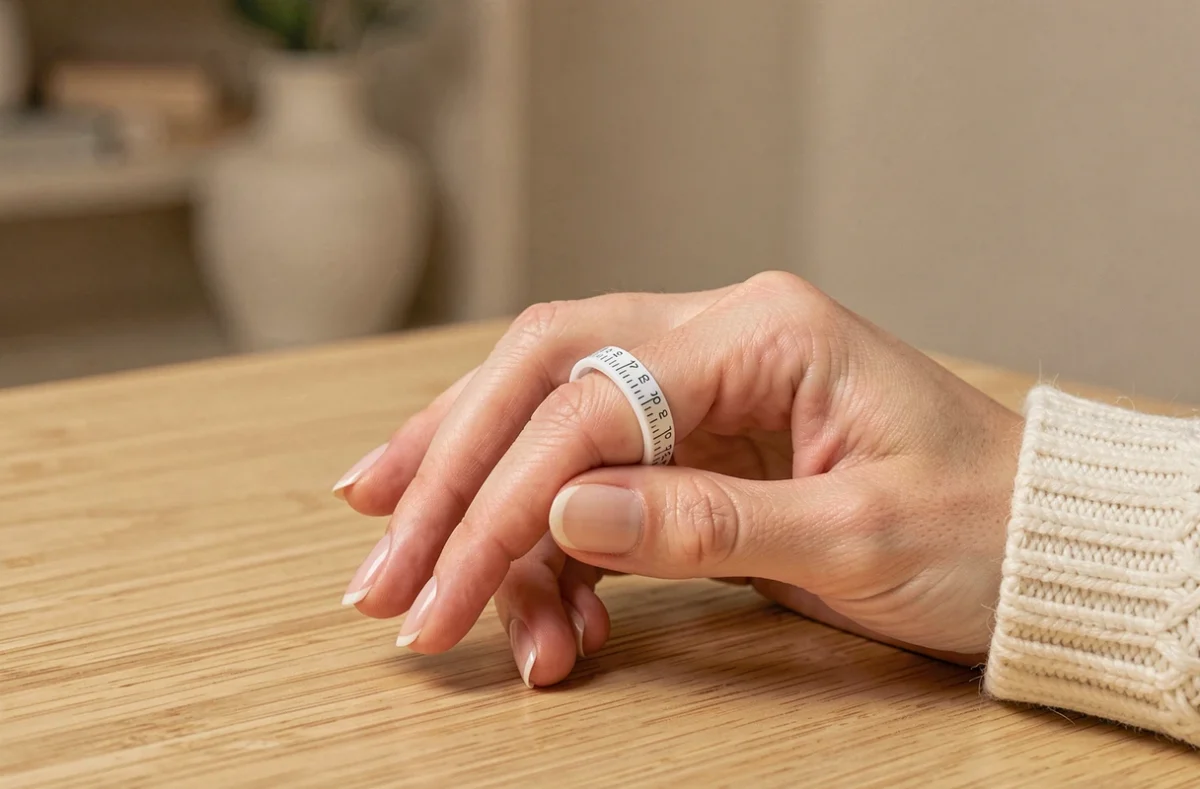
In France, the United States, or with certain brands that have their own sizing chart, the number 9 can refer to an inner diameter ranging from 15.6 mm to about 19 mm. This considerable discrepancy accounts for a significant portion of returns in online jewelry. Understanding the correspondence between ring size 9 and millimeters first requires identifying the measurement reference, then checking one’s own finger size with a reliable method.
Size 9 in mm: three systems, three different realities
The main trap can be summed up in one sentence: the number “9” has no universal value in jewelry. Here’s what a size 9 looks like according to the three most common references.
| System | Size 9 – Inner diameter | Size 9 – Finger size (circumference) |
|---|---|---|
| US / international | about 18.9 mm | about 59-60 mm |
| France (size = circumference) | not applicable (the “9” does not exist in FR) | not applicable |
| Internal numbering of certain brands (e.g., Lilou Paris) | about 15.6 mm | about 49 mm |
In the French system, the size directly corresponds to the circumference in millimeters. A size 60 means a finger circumference of 60 mm, which corresponds to an inner diameter of about 19 mm. Therefore, the number “9” does not appear in the standard French nomenclature.
On the other hand, in US sizing, 9 is a common size that corresponds to an inner diameter of about 18.9 mm and a finger size of 59 to 60 mm. This roughly corresponds to a size 59 or 60 in the French system.
The third case is the most misleading. Some brands adopt a numbering from 1 to 20 unrelated to the US system. At Lilou Paris, size 9 corresponds to a diameter of 15.6 mm and a circumference of 49 mm, which is nearly 10 mm less in finger size than US size 9. Ordering without checking the seller’s reference is like playing heads or tails.
Knowing the correspondence between ring size 9 and mm thus involves a preliminary step: identifying whether the merchant site uses the US system, the French system, or its own internal chart.
Measuring your finger size in millimeters: a reliable method at home
Two techniques yield usable results without professional equipment. The common point: always measure in millimeters, then convert.
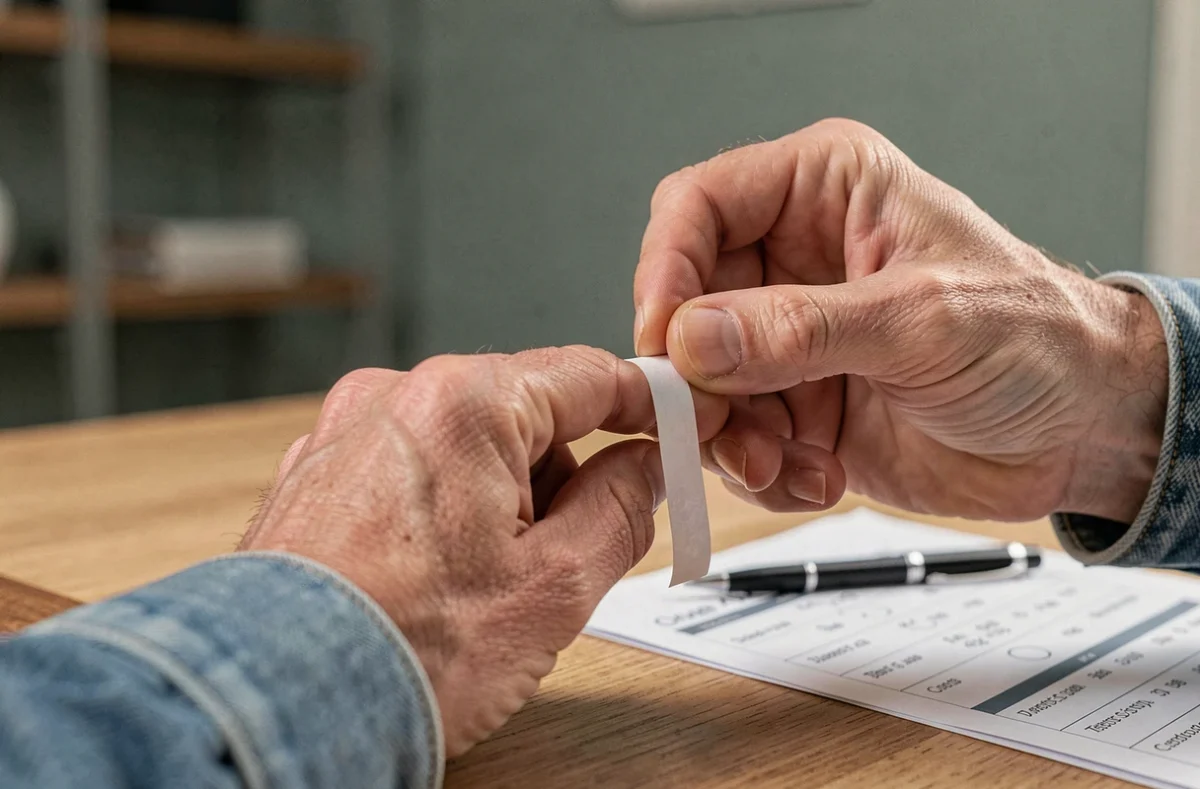
Measurement with string or paper strip
- Wrap a thin string or a strip of paper (about 5 mm wide) around the base of the finger in question, without tightening to the point of compressing the skin, but without leaving any slack either
- Mark with a pen the exact point where the string overlaps, then unroll it and measure the length between the edge and the mark with a ruler graduated in millimeters
- Repeat the measurement at least three times at different times of the day, as the diameter of the finger varies with temperature and time
The value obtained is the circumference. To get the inner diameter, divide this number by 3.14. A finger size of 59 mm gives an approximate diameter of 18.8 mm.
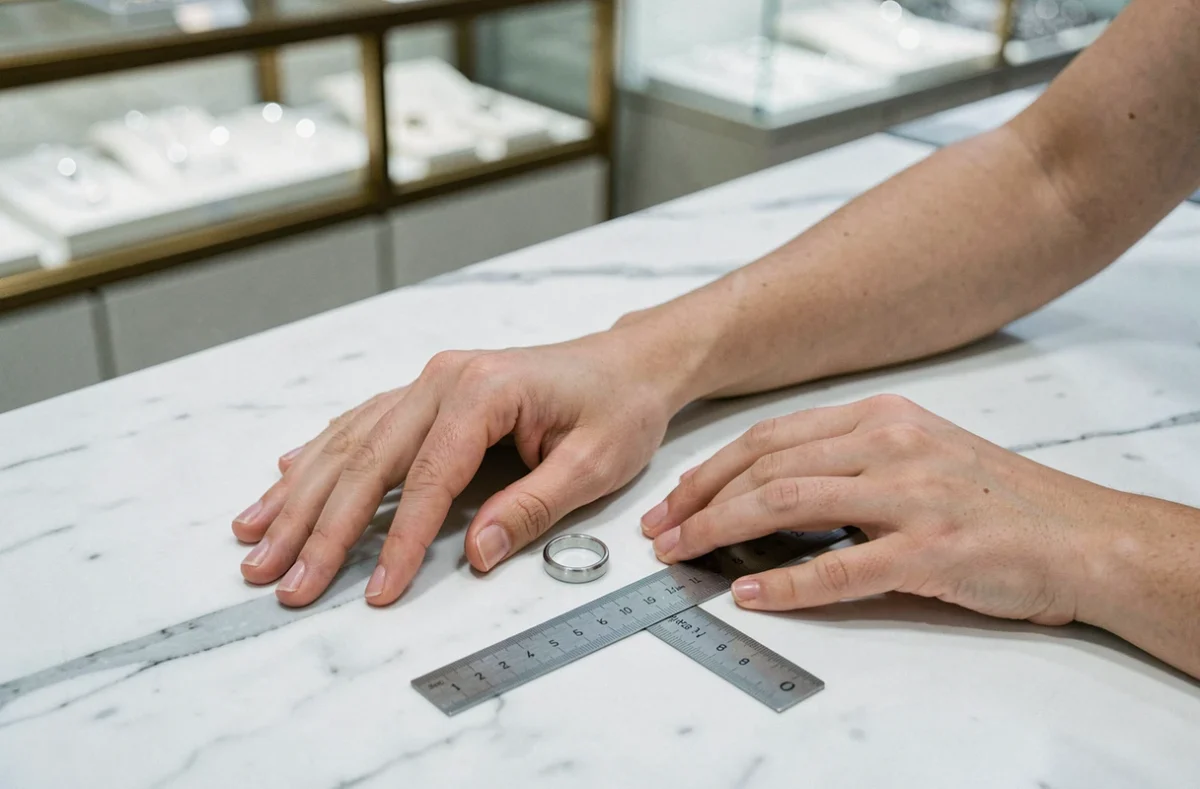
Measurement from an existing ring
Place a well-fitting ring on a ruler and measure its inner diameter in millimeters. This method is quicker and often more accurate, provided the reference ring is indeed the correct size.
Digital ring sizer on smartphone: conditional reliability
Several jewelers offer virtual ring sizers to display on the phone screen. The principle is to place an existing ring on a circle displayed on the screen and adjust until it matches. The tool seems practical, but its accuracy depends entirely on calibration.
The pixel density varies from one smartphone to another. A circle meant to represent 19 mm in diameter may actually measure 18 or 20 mm depending on the device. Zoom settings, system font size, and even the thickness of a screen protector film can alter the visual rendering at the edges of the circle.
An uncalibrated digital ring sizer can lead to an error of one to two sizes. To limit this risk, serious tools require placing a coin or a credit card on the screen before measuring, to recalibrate the proportions. Without this calibration step, the result is not very usable.
Variations in finger size: factors to consider before ordering
Even with an accurate measurement, finger size is not constant. Several physiological factors modify the circumference throughout the day and the seasons.
- Heat expands tissues: a finger measured in summer may be significantly wider than in winter, which explains why a ring that fits perfectly in July may become too loose in December
- In the morning, fingers are often slightly swollen due to fluid retention during sleep; the most representative measurement occurs in the middle of the day
- Physical effort and salt consumption also influence finger volume in the short term
For a wide ring (band over 6 mm), it is advisable to choose a half size above the measured size. A wide band rubs more against the skin and passes more difficultly over the joint than a thin band of the same diameter.
Summary table of US size, finger size, and diameter
| US Size | Finger Size (mm) | Inner Diameter (mm) | Approximate FR Size |
|---|---|---|---|
| 7 | 54.5 | 17.3 | 54-55 |
| 8 | 57 | 18.1 | 57 |
| 9 | 59-60 | 18.9 | 59-60 |
| 10 | 62 | 19.8 | 62 |
This table covers the most requested US sizes around 9. The French size being directly expressed in millimeters of circumference, the conversion is immediate once the finger size is measured.
The key takeaway remains simple: before placing any order, check which sizing system the seller uses, measure yourself in millimeters, and convert rather than relying on an isolated number. A size “9” without a reference means nothing.