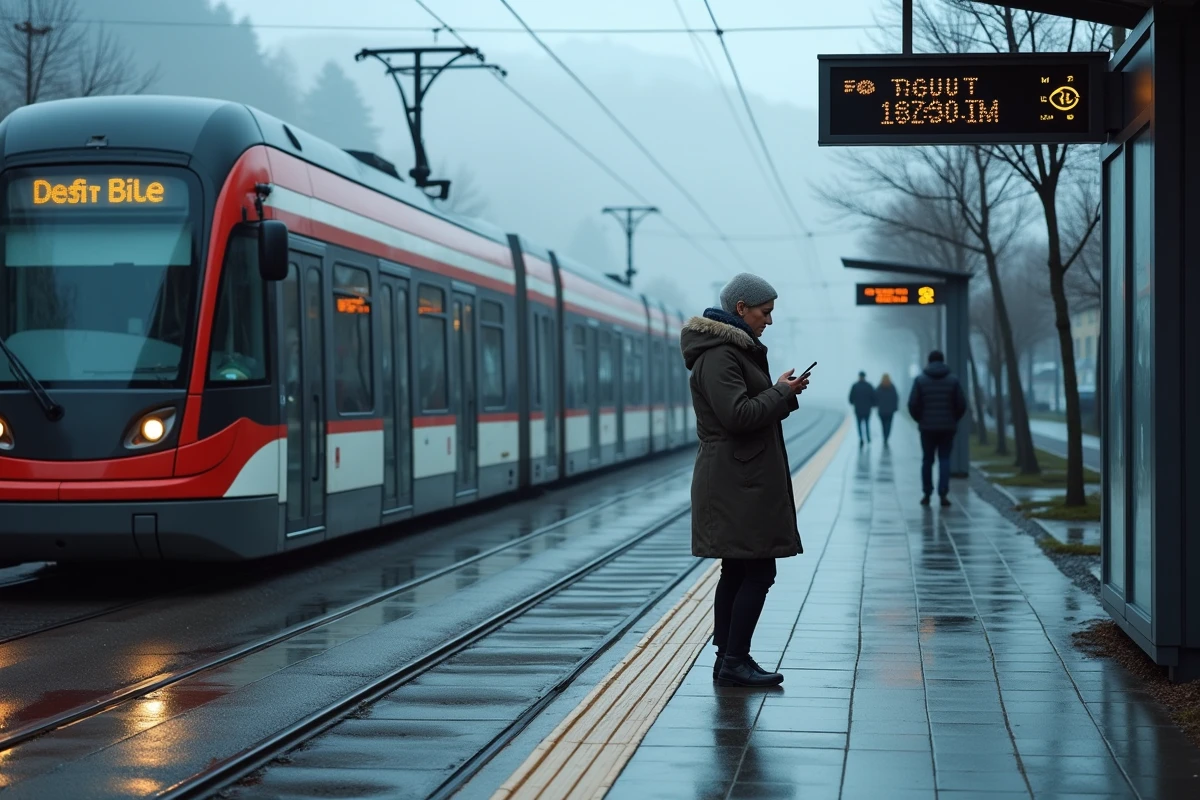
The Grenoble tram network serves the metropolitan area with four lines (A, B, C, and D), with operating hours that cover the day and part of the evening. For users who work unconventional hours, return late, or need to travel before dawn, the tram alone is not enough. The issue of nighttime and very early morning trips remains a recurring friction point in the agglomeration.
LOM Law and atypical working hours: what Grenoble has actually implemented
The Mobility Orientation Law (LOM) requires mobility authorities to consider the travel needs related to working unconventional hours. In Grenoble, Grenoble Alpes Métropole and the M’ network (formerly M TAG) have integrated this obligation into their consultations on transport offerings.
The metropolitan documents explicitly mention the needs of employees with atypical hours. However, this consideration has not led to the creation of a daily nighttime tram service. The network remains fixed on a schedule that ends in the evening, without regular service in the middle of the night.
For users looking for solutions for tram schedules in Grenoble outside of this timeframe, the answer lies in a set of complementary measures rather than an extension of the tramway itself.
Chrono lines and late-night buses: the real backbone of evening transport in Grenoble
The M’ network has structured its evening service around two levels of service. The tram lines and the Chrono lines C1 to C8 operate until 1 AM in the heart of the metropolitan area. The Chrono lines C9 to C14 serve users until 10 PM and reach more distant destinations such as Vizille, Voiron, or Crolles.

This structure creates a clear gap between the city center and the peripheral municipalities. A user working in the city center has decent coverage until 1 AM. However, someone needing to reach a municipality served by lines C9 to C14 loses two to three hours of service in comparison.
For the time slot between 1 AM and the first morning service, no regular line takes over. This is a blind spot in the network, accepted by the community, which concentrates its resources on peak demand periods.
What the M’ network covers after 10 PM
- The four tram lines (A, B, C, D) and the Chrono C1 to C8 operate until around 1 AM, with reduced frequency compared to the daytime
- The Chrono C9 to C14 stop around 10 PM, leaving the second-ring municipalities without public transport in the late evening
- The Flexo lines, which require reservations, occasionally supplement the service in certain low-density areas, but their time slots remain limited
Event-based nighttime reinforcements: the case-by-case logic in Grenoble
Since the transition to the M’ network, the metropolitan area has experimented with extended hours during major events: Fête des Tuiles, student nights, major concerts. These targeted nighttime reinforcements concern certain key lines (tram and Chrono) and are subject to dedicated communication, particularly on the M’ network’s social media.
This approach reveals a strategy of “event-driven nighttime service” rather than a commitment to a permanent nighttime service. The metropolitan area tests demand on a case-by-case basis, without guaranteeing recurrence.
For regular users with unconventional hours, this logic poses a predictability problem. The extensions are not included in the standard timetables and depend on announcements made a few days before the event. No annual schedule of nighttime reinforcements is published at this stage.
Concrete alternatives between 1 AM and 5 AM in the Grenoble agglomeration
The deep night slot relies on an organized complementarity between several modes of transport, encouraged by the metropolitan area itself.
The network’s digital tools (route calculator on the M’ website and the mobile app) are gradually integrating multimodal suggestions including carpooling and VTC. The idea is not to replace the tram but to guide users to partner platforms when the public network is inactive.
At the same time, recurrent disruptions in the tram network (road works, technical incidents, sporting events) have led to an increase in substitution plans in the evening and at night. Replacement buses are deployed on main routes when a tram line is interrupted, which has allowed for the development of a logistics system for occasional nighttime transport.
Available options for a nighttime trip in Grenoble
- Carpooling via platforms referenced by the metropolitan area, suitable for recurring home-work trips during unconventional hours
- VTC and taxis, the only accessible individual motorized option without a personal vehicle between 1 AM and 5 AM
- Self-service bicycles and secure bike lanes, usable for short trips in the city center, including at night
- Park-and-ride facilities at tram terminals, allowing for a combination of personal car and public transport as soon as morning service resumes
Permanent nighttime tram in Grenoble: why the network is not there yet
Several French cities (Lyon, Strasbourg, Bordeaux) have established regular nighttime transport services on certain lines. In Grenoble, the available data does not support the conclusion that nighttime demand would economically justify a continuous tram service.
The Grenoble metropolitan area has chosen to prioritize the geographical extension of the network and the improvement of daytime frequencies. The extension of line C13 until 10 PM, announced in the M’ network’s communication, illustrates this logic of gradual expansion of service hours rather than a leap to full nighttime operation.
Field feedback varies on this point: user associations and some local elected officials advocate for at least one tram line with reduced service between 1 AM and 5 AM, while the operator highlights the maintenance constraints of the tracks, which require a nighttime window without traffic.
The current model relies on a compromise where the tram covers the majority of demand until 1 AM, leaving the deep night to individual and shared modes. For users with very unconventional hours, the reliability of this system largely depends on the quality of digital alternatives and the actual availability of options on the ground.