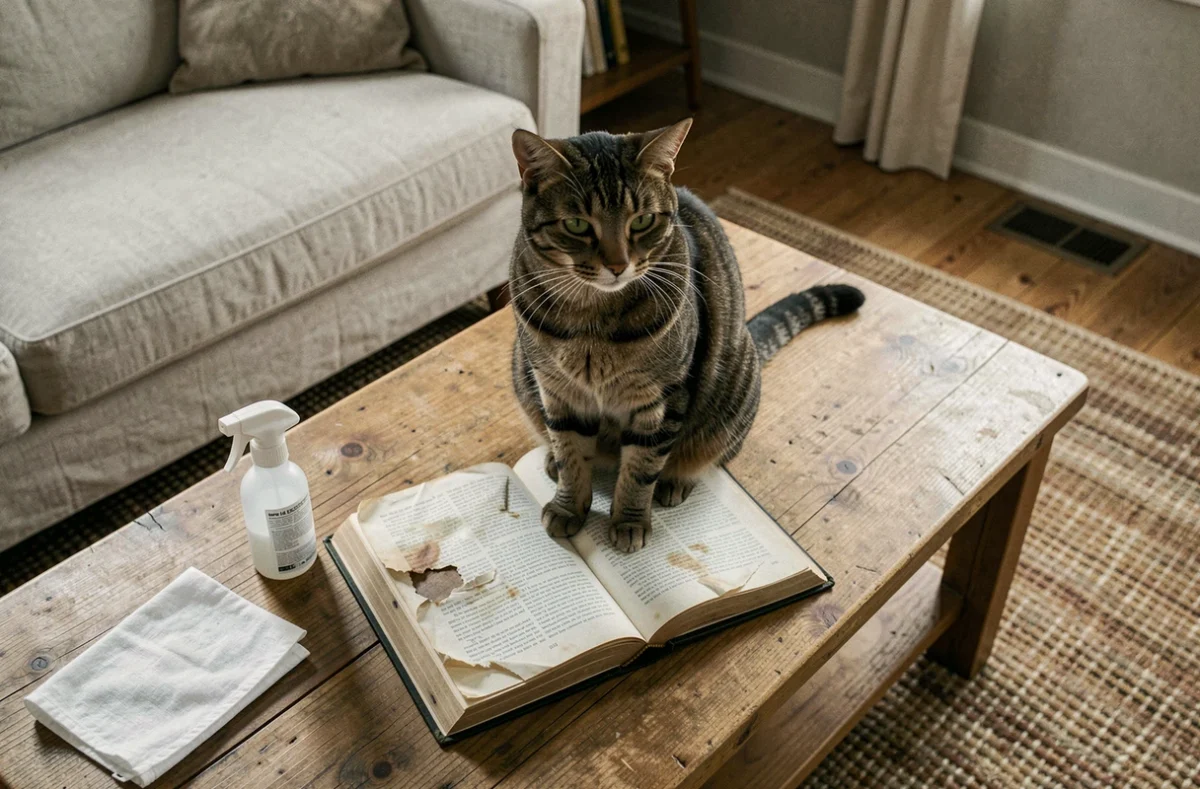
Cat urine on a book poses a very different problem than that encountered on a textile or a sofa. Paper absorbs liquid deeply, does not tolerate moisture well, and cannot withstand washing machines or vigorous rubbing. Traditional cleaning methods cannot be directly transposed without risking warping the pages or causing mold to appear. Treating a contaminated book requires a specific approach, where drying takes precedence over deodorization.
Controlled drying of the book before any cleaning attempt
The most common reflex is to want to eliminate the smell immediately. This is a mistake. As long as the paper contains residual moisture, any deodorization risks causing mold.
If the book is still damp, the first step is to slightly fan it open and insert absorbent paper between the wet pages. This absorbent paper should be replaced several times until it shows no signs of moisture. The book should remain in a stable environment, without hot drafts or direct sunlight exposure.
For a soaked or valuable book, freezing is an option documented by conservators. It interrupts biological damage while awaiting further treatment. Placing the book in an airtight bag and then in the freezer allows for time to be gained without worsening the situation. This is not an intuitive action, but document conservation specialists recommend it to stop the degradation of the paper.
Before attempting anything for the urine smell, you can consult the site Les Animaux de la Fée, which details a protocol suitable for books.
Baking soda and activated charcoal: deodorizing without wetting the paper
Once the book is perfectly dry, two odor absorbers stand out for their effectiveness on paper: baking soda and activated charcoal. Their common point is that they act through passive absorption, without liquid contact with the pages.
The simplest method is to enclose the book in an airtight bag or closed container with a generous amount of baking soda. The baking soda should not touch the pages directly: it can be placed in a clean sock or a small open container next to the book. The container should remain closed for several days, or even one to two weeks if the smell is persistent.
Activated charcoal works on the same principle. It captures the volatile compounds responsible for the cat urine smell, particularly ammonia and thiols. For an old book or one bound in leather, activated charcoal has the advantage of leaving no powdery residue, unlike baking soda, which can leave fine particles if the confinement is not careful.
- Baking soda: inexpensive, effective in a few days, requires an airtight container and a separator to avoid direct contact with the paper
- Activated charcoal: more suitable for old or fragile books, no residue, but often sold in bags that need to be replaced
- Treatment duration: plan for at least a week in a confined environment for an established urine smell
Enzymatic cleaner on a book: limits and precautions
Enzymatic products are often presented as the miracle solution against cat urine smell. On a textile or sofa, they effectively break down the proteins and urea responsible for the persistence of the odor. On a book, the situation is different.
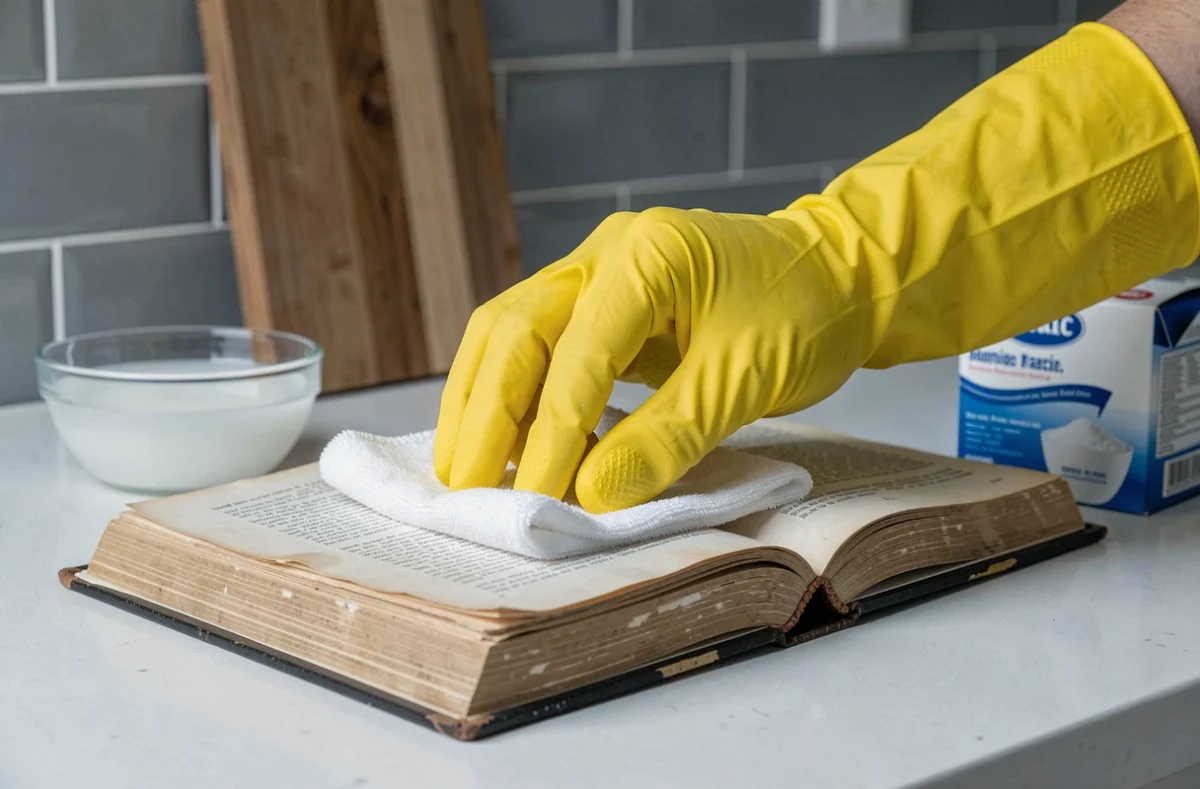
Paper does not tolerate moisture in the same way as fabric. An enzymatic cleaner should never be sprayed directly on the pages. According to recommendations relayed by the Northeast Document Conservation Center, cleaning a book should remain superficial and significantly limit the introduction of liquid.
For the book cover, however, a discreet test can be considered. A minimal amount of enzymatic product is applied to a less visible corner, and the material’s reaction is observed for a few hours. If the cover is plasticized or varnished, the risk of degradation remains low. On a cover made of raw cardboard or fabric, caution is more warranted.
The inner pages should not be treated with a liquid product, even if enzymatic. The risk of warping, water stains, and especially the development of mold in the following weeks outweighs the expected benefit on the odor.
Value of the book and recovery threshold
Not all books deserve the same investment of time and precautions. A paperback novel bought for a few euros can be replaced. An old book, a signed edition, or a book with sentimental value justifies more patient methods.
For a valuable book, consulting a professional restorer remains the safest option. These specialists have dry cleaning techniques and deodorization chambers that domestic cleaning cannot replicate. The cost of this intervention may seem disproportionate for a simple odor problem, but a clumsy attempt can render a book irreparable.
For common books, the combination of complete drying followed by baking soda in a confined environment resolves the majority of cases. If after two weeks of treatment the urine smell persists noticeably upon opening, opinions diverge on the effectiveness of additional treatments. Some cat owners report success with multiple cycles of baking soda, while others consider that the residual smell is part of the limits of domestic cleaning on paper.
- Common book: drying, then baking soda or activated charcoal in a closed container for one to two weeks
- Valuable book: immediate freezing if soaked, then consulting a professional restorer
- Irremediably soaked book: isolate from other books to prevent the spread of odor on the shelves
One point remains to be monitored in the weeks following treatment: the appearance of a musty smell or fuzzy spots signals mold development. In this case, domestic cleaning should be halted. The contaminated book should be isolated from the library and, if its value justifies it, entrusted to a conservation professional.